Spring Wildflowers Seamless Patterns
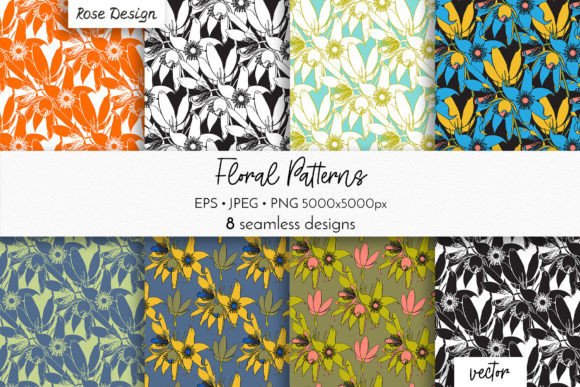
Spring Wildflowers Seamless Patterns is a curated digital collection of eight original, hand-drawn seamless patterns featuring spring wildflowers—most notably fluffy purple pasque flowers native to forested regions in early spring. The designs are available in multiple file formats and color treatments: full-color and black-and-white versions, each delivered as high-resolution raster and vector assets. This makes the collection suitable for both digital design workflows and physical production applications.
The set includes three core file types per pattern: 8 JPG files (5000×5000 pixels, RGB, high-resolution for print-ready use), 8 EPS10 vector files (scalable, editable, compatible with Adobe Illustrator and other vector editors), and 8 PNG files with transparent backgrounds (ideal for layering or web-based mockups). All assets are optimized for clarity and fidelity at large scales, supporting applications such as wrapping paper, textile printing, greeting cards, pillow covers, scrapbooking elements, stationery, and surface design projects.
One key technical strength lies in the inclusion of EPS10 vector files. Unlike raster images, vectors retain sharpness at any size and allow straightforward recoloring—users can adjust individual flower elements, stems, or background tones without quality loss. This flexibility supports brand alignment, seasonal adaptation, or accessibility-focused contrast adjustments. The black-and-white variants further extend utility, enabling screen printing, engraving previews, or monochrome textile applications where color separation is required.
A practical benefit of this collection is its consistency across formats. Each pattern is built from the same underlying hand-drawn artwork, ensuring visual harmony whether used on fabric, paper, or digital interfaces. The pasque flower motif—recognizable by its soft, layered petals and delicate stem structure—offers botanical authenticity without excessive detail that might hinder scalability or reproduction fidelity. That balance makes the patterns especially appropriate for medium-to-large repeat applications, such as wallpaper or fabric yardage, where clarity and rhythm matter more than microscopic realism.
However, users should consider several tradeoffs before selecting Spring Wildflowers Seamless Patterns. First, the collection focuses narrowly on one botanical subject and season. While pasque flowers evoke early spring effectively, it does not include daffodils, cherry blossoms, violets, or other common spring motifs. Designers seeking broader seasonal variety may need to supplement this set with additional resources. Second, the patterns are pre-designed—not customizable templates. There’s no built-in interface for rearranging elements or adjusting repeat spacing; modifications require vector editing proficiency. Beginners unfamiliar with Illustrator’s path tools or layer management may face a learning curve when adapting the EPS files.
Another consideration is resolution context. Though the JPGs are 5000×5000 px—a standard for high-quality print—the actual usable scale depends on output method and viewing distance. For fine-art giclée prints or close-view items like greeting cards, this resolution is ample. For billboard-scale murals or large-format textiles viewed from afar, the same files remain technically sufficient, but designers should verify tiling behavior in their specific layout software to avoid unintended seam visibility. The seamless nature of each pattern helps mitigate this, but real-world testing on target substrates remains advisable.
This collection is a strong fit for designers working on cohesive, nature-inspired product lines—such as boutique stationery brands launching spring collections, small-batch textile studios developing limited-edition pillow covers, or crafters producing custom scrapbooking kits. Its emphasis on hand-drawn texture and organic line work suits audiences valuing artisanal aesthetics over hyper-realistic or minimalist trends. It also aligns well with sustainability-minded creators, as the black-and-white variants support low-ink printing options and the vector files reduce the need for repeated asset generation.
Conversely, alternatives may be preferable in certain scenarios. For example, users needing photorealistic floral textures—like macro shots of dew-covered petals—would benefit more from high-res photographic pattern libraries or procedural texture generators. Those requiring animated or interactive versions (e.g., for web backgrounds with subtle motion) won’t find those capabilities here, as all files are static. Similarly, designers constrained by licensing restrictions—such as those creating client work under strict commercial-use clauses—should review the included license terms carefully, as usage rights for resale products (e.g., printed-on-demand merchandise) often differ from personal or internal project allowances.
Practical decision-making starts with clarifying intended use. Ask: Will the patterns appear on physical goods? If yes, confirm substrate compatibility—some printers prefer TIFF over JPG for CMYK workflows, and not all services accept EPS directly (PDF export may be needed). Is color flexibility essential? Then prioritize the EPS10 files and verify your software supports them. Are transparency and layering critical—for example, overlaying text or logos? The PNGs with transparent backgrounds serve that purpose directly, while JPGs do not.
Also consider workflow integration. Vector-based design teams can leverage the EPS files for rapid iteration, but raster-only environments (e.g., Photoshop-heavy studios) may rely primarily on the JPGs and PNGs, limiting recoloring options to pixel-level adjustments. In such cases, evaluating whether the provided colorways match project requirements becomes more important—and previewing the black-and-white versions for tonal contrast helps assess suitability for grayscale outputs.
Finally, compare against alternatives not just by feature count, but by alignment with long-term needs. A larger bundle with 50+ patterns may offer variety but lack the focused botanical cohesion of Spring Wildflowers Seamless Patterns. A lower-priced set with only JPGs may save budget but forfeit scalability and editing control. The value here lies in curation, format diversity, and intentional design—not volume.
In summary, Spring Wildflowers Seamless Patterns serves designers who prioritize hand-crafted authenticity, need reliable print-ready assets, and work across both digital and physical mediums. It supports iterative, scalable use through vector files while delivering immediate usability via high-res raster and transparent PNG options. Success depends less on the number of patterns and more on whether the specific botanical theme, technical specifications, and file versatility match the scope and constraints of your current or upcoming project.