Seamless Patterns with Female Faces: Versatile Digital Assets for Creative Projects
What Are Seamless Patterns with Female Faces?
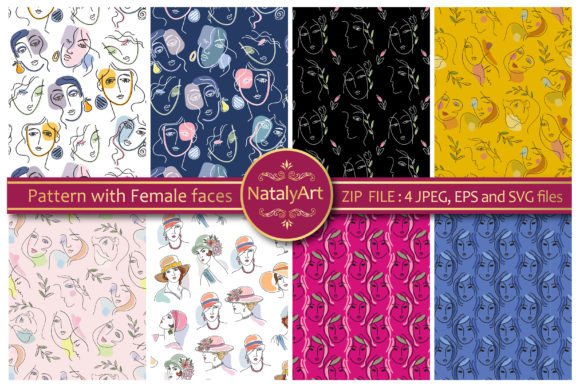
Seamless patterns with female faces are digitally designed repeating motifs where stylized, hand-drawn illustrations of women’s faces tile perfectly—without visible seams or gaps—across any surface. Unlike standalone portraits or isolated clipart, these patterns are engineered so that the top edge aligns flawlessly with the bottom, and the left with the right, enabling infinite repetition. The specific collection described here features four distinct designs: each showcases a unique hand-drawn line-art interpretation of a woman’s face—delicate, expressive, and intentionally minimalist—optimized for professional use across textiles, print, and digital media.
Why Choose Hand-Drawn Line Art in Seamless Design?
Hand-drawn line art brings warmth, authenticity, and human nuance to digital design. In contrast to rigid vector icons or AI-generated symmetry, these illustrations retain subtle variations in stroke weight, curvature, and rhythm—qualities that evoke personality and emotional resonance. When embedded into a seamless pattern, that organic character scales beautifully: whether enlarged on a wallpaper mural or reduced to a subtle background texture on a wedding invitation, the linework remains elegant and legible.
This aesthetic bridges tradition and technology. Artists sketch by hand first, then digitize and refine using vector tools—ensuring precision without sacrificing soul. As a result, designers gain both artistic integrity and technical flexibility: SVG and EPS files preserve infinite scalability, while high-resolution JPEGs (300 dpi, 10×10 inches, RGB) guarantee crisp output for physical products like fabric rolls or gift wrap.
Practical Applications Across Industries
These seamless face patterns aren’t niche novelties—they’re functional creative assets with wide-ranging utility:
- Fabric Printing: Ideal for apparel (scarves, dresses), home textiles (curtains, pillow covers), and craft projects. The 10×10 inch size maps cleanly to standard fabric printing grids, minimizing waste and simplifying repeat setup in programs like Adobe Illustrator or Spoonflower’s uploader.
- Wallpapers & Home Decor: From accent walls to ceramic tile decals, the subtle repetition creates visual interest without overwhelming space. Interior designers use such patterns to add quiet sophistication—think botanical cafes, boutique hotels, or wellness studios seeking calm, feminine energy.
- Web & UI Design: As CSS background images or SVG fills, they lend brand personality to websites, dashboards, or email templates—especially for lifestyle brands, therapists, educators, or creatives wanting soft, approachable visuals.
- Stationery & Invitations: Wedding suites, baby announcements, or editorial layouts benefit from the tactile feel of line art. Because the patterns are light and non-distracting, text remains highly readable over them—even at low opacity.
- Packaging & Gift Papers: Eco-conscious brands choose these for recyclable wrapping paper or product boxes: the monochrome-friendly line work prints cleanly on kraft, soy-based inks, or foil-stamped stock.
File Formats Explained: Why Four Types Matter
The included Zip file delivers four formats—SVG, EPS, JPEG—for each of the four patterns. Here’s why variety matters:
SVG Files (Scalable Vector Graphics)
Perfect for web use and responsive design. SVGs load quickly, scale infinitely without pixelation, and support CSS styling (e.g., changing line color on hover). They’re editable in Figma, Illustrator, or even code editors—ideal for developers integrating patterns directly into HTML backgrounds or animated interfaces.
EPS Files (Encapsulated PostScript)
A legacy but still essential format for professional print workflows. Most large-format printers, textile mills, and offset presses accept EPS natively. Its vector nature ensures razor-sharp edges at any size—critical when printing yardage or billboard-scale murals.
JPEG Files (High-Resolution Raster)
At 300 dpi and 10×10 inches, these are production-ready for print-on-demand services (like Printful or Zazzle), photo labs, or desktop printers. RGB color mode ensures accurate screen-to-print fidelity for digital-first creators who don’t manage CMYK conversions themselves.
Having all three formats means no workflow bottlenecks: designers skip conversion steps, avoid licensing surprises, and maintain full creative control—from concept to shelf.
Common Misconceptions—Clarified
Misconception #1: “Seamless = boring.”
Not true. Repetition doesn’t mean monotony. These patterns use asymmetrical balance, varied facial expressions (eyes closed, looking up, gentle smiles), and intentional negative space—creating rhythm, not redundancy. Think of them like musical motifs: familiar yet evolving with each repeat.
Misconception #2: “Line art lacks versatility.”
On the contrary—line drawings are among the most adaptable assets. They layer effortlessly over photos, blend with gradients, convert cleanly to embroidery stitch files, or serve as underlays for watercolor textures. Their simplicity invites customization, not limitation.
Misconception #3: “One size fits all surfaces.”
While the 10×10 inch base is industry-standard, smart scaling matters. For fabric, smaller repeats (e.g., 4×4 inches) suit blouses; larger ones (12×12+) work for drapery. The provided files let you resize non-destructively—just re-tile in your design software to match project needs.
How These Patterns Support Modern Creative Workflows
In today’s fast-paced digital landscape, time is a premium resource. Pre-made seamless patterns eliminate hours of manual tiling, alignment testing, and export troubleshooting. But more importantly, they uphold creative intention: rather than defaulting to generic geometric repeats or overused stock motifs, designers anchor their work in meaningful visual language—faces symbolize identity, empathy, and connection.
Educators use them in art curricula to teach pattern theory, cultural symbolism of portraiture, or vector fundamentals. Small-business owners integrate them into Canva templates for social media banners or Shopify store backgrounds—building cohesive, memorable branding without hiring an illustrator. Even hobbyists find joy in personalizing planners, stickers, or DIY greeting cards with emotionally resonant imagery.
Getting Started: Tips for Best Results
Whether you’re new to pattern design or refining your process, consider these practical tips:
- Test before committing: Import the SVG into your design tool and duplicate it into a 3×3 grid. Zoom out—look for stray anchor points, inconsistent spacing, or unintended overlaps at tile boundaries.
- Adjust color thoughtfully: Since the originals are line-based, try tinting strokes via CSS (
filter: hue-rotate(60deg)) or Illustrator’s Recolor Artwork tool—not just fill changes—to preserve clarity. - Respect scale context: On fabric, test a swatch first. A delicate 10×10 pattern may vanish on coarse linen but shine on silk. For web, set background-attachment to fixed or scroll depending on parallax goals.
- Pair with typography wisely: Use clean, medium-weight sans-serifs (e.g., Inter, Lato) or soft serifs (e.g., Cormorant Garamond) to complement—not compete with—the hand-drawn lines.
Final Thoughts: More Than Just Decoration
Seamless patterns with female faces represent a thoughtful convergence of artistry, utility, and inclusivity. They move beyond decoration to become quiet storytellers—suggesting presence, diversity, and humanity in everyday objects. Whether printed on a child’s lunchbox, projected behind a keynote speaker, or stitched onto a handmade quilt, they remind us that design isn’t just about how something looks—it’s about how it makes people feel.
With ready-to-use SVG, EPS, and JPEG files—each crafted for real-world application—this collection empowers creators to work efficiently without compromising vision. It’s not just a download. It’s a toolkit for empathy, expression, and enduring beauty.