24 Monochrome Seamless Star Patterns
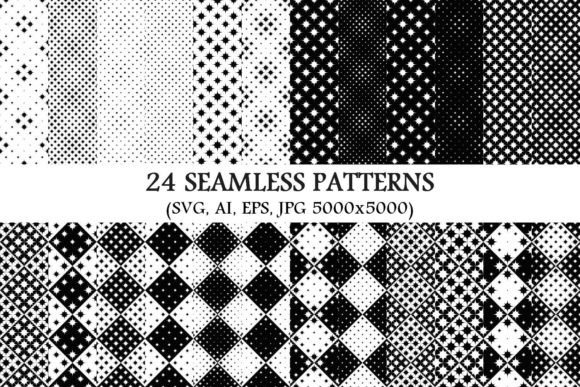
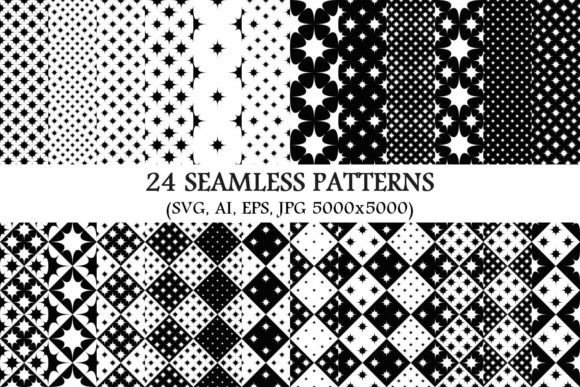
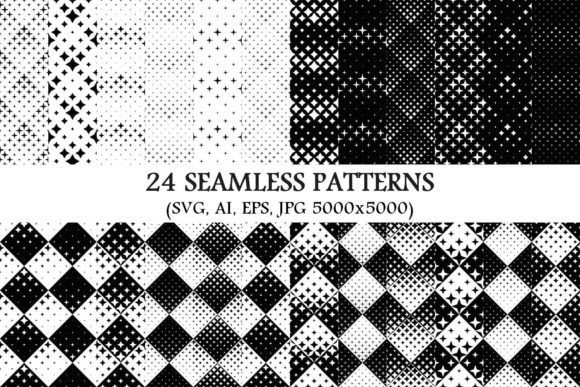
For designers, marketers, and content creators who rely on clean, scalable, and production-ready assets, the 24 Monochrome Seamless Star Patterns package offers a focused solution—not flash, but function. It’s not a sprawling library or a trend-chasing bundle. Instead, it delivers two tightly curated sets: 24 monochrome seamless star patterns and 24 seamless monochrome curved octagram star patterns—each designed for reliability across print, digital, and branding workflows.
What You Actually Get—and Why Format Variety Matters
The package includes 24 vector SVG files, 24 vector AI files, 24 vector EPS files, and 24 high-resolution JPGs (5000×5000 pixels). That format diversity isn’t decorative—it reflects real-world constraints. SVG ensures crisp rendering at any scale in web interfaces and modern CMS platforms. AI and EPS files preserve full editability in Adobe environments—essential when adjusting stroke weight, spacing, or color tints for brand alignment. The JPGs serve immediate needs: social media banners, presentation backgrounds, or quick mockups where vector support isn’t available or practical.
Each pattern is truly seamless—tested across tile boundaries in Illustrator, Figma, and CSS background declarations. No visible seams, no manual offsetting required. That consistency saves time during layout iterations, especially when applying patterns to large-format prints or responsive web elements that scale unpredictably.
Design Integrity: Simplicity with Intention
“Monochrome” here means purposeful restraint—not just grayscale, but intentional tonal range. Patterns use only black, white, and neutral grays, avoiding automatic desaturation artifacts. This makes them adaptable: they accept global color overlays in design tools without banding or clipping, and convert cleanly to single-color spot printing (e.g., foil stamping or letterpress).
The star motifs balance geometry and rhythm. The first set features classic radial symmetry—sharp-pointed, evenly spaced stars ideal for technical illustrations, data visualizations, or minimalist packaging accents. The second set—the curved octagrams—introduces subtle organic flow: softened angles, gentle arcs between points, and rhythmic negative space. These work well where warmth and approachability matter: educational materials, wellness branding, or editorial layouts seeking visual interest without visual noise.
Real-World Usability Across Common Workflows
In practice, these patterns hold up under scrutiny. A freelance UX designer used the curved octagrams as subtle background textures behind form fields in a healthcare SaaS dashboard—adjusting opacity to 8% in Figma to improve readability without sacrificing sophistication. An indie publisher applied the sharp star patterns as repeating motifs on book spine wraps, scaling them to 12mm height with zero pixelation on physical proofs.
For educators building slide decks, the JPG versions load reliably in PowerPoint and Google Slides—even on older hardware—without triggering “low-res warning” prompts. And because all files are natively vector-first, resizing for retina displays or billboard mockups requires no re-exporting or quality compromise.
Who Benefits Most—and Where It Fits (and Doesn’t Fit)
This isn’t a universal asset pack. It excels for professionals who need precision, not variety. Small business owners launching a cohesive brand identity often overbuy pattern libraries—only to default to three go-to motifs anyway. With 24 Monochrome Seamless Star Patterns, those three are already vetted, consistent in style, and technically robust.
Marketers running A/B tests on email header backgrounds found the monochrome constraint helpful: it removed hue-based variables, letting them isolate how pattern density or rhythm affected open rates. Similarly, product photographers embedding subtle texture into e-commerce studio shots used the JPGs as non-distracting backdrop layers—no licensing ambiguity, no attribution overhead.
That said, it’s not suited for projects requiring chromatic complexity, photorealistic texture, or illustrative storytelling. If your work depends on gradients, hand-drawn imperfection, or culturally specific symbolism, this package won’t stretch to meet those needs. Its strength lies in disciplined repetition—not narrative expression.
Practical Integration Tips
- For web developers: Import SVGs directly into CSS via
background-image: url(...). Usebackground-sizeto control tile scale responsively—no JavaScript needed. - For print production: Embed EPS files directly into InDesign layouts. Their PostScript compatibility avoids RIP errors common with complex SVG imports in commercial printing pipelines.
- For branding consistency: Convert one SVG pattern to a custom CSS property (e.g.,
--star-pattern: url(...)) and reuse across component libraries—ensuring uniform application across marketing sites and internal tools. - To extend flexibility: Open AI files and adjust the base gray value using Global Colors. Then recolor entire pattern sets with one edit—no batch-replace scripting required.
Long-Term Value and Technical Longevity
Vector formats ensure longevity. Unlike raster-only packs that degrade with every rescale or format conversion, these assets remain editable and resolution-independent for years. The AI and EPS files conform to industry-standard vector specifications (CS6+ and EPS 10), meaning they’ll open in current and near-future design tools without migration friction.
There’s also minimal technical debt. No fonts to license, no embedded images to relink, no layered PSDs requiring version-specific software. Each file is self-contained, lightweight (average SVG: under 12 KB), and built with flat paths—no unnecessary compound paths or hidden layers that bloat file size or cause export hiccups.
A Measured Assessment
What stands out about 24 Monochrome Seamless Star Patterns isn’t novelty—it’s executional rigor. The patterns avoid visual fatigue through balanced density: none overwhelm at small scales, and none vanish at large ones. Spacing between motifs follows typographic rhythm principles—not arbitrary padding—so they integrate naturally alongside text blocks or UI components.
It’s also refreshingly free of bloat. No “bonus” files, no upsold add-ons, no duplicate variants labeled differently. What’s listed is what’s delivered—and each item fulfills its stated role. That kind of clarity matters when managing asset libraries across teams or client projects where version control and documentation are part of the workflow—not an afterthought.
If your work involves recurring need for structured, professional-grade pattern assets—and you prioritize technical reliability over stylistic breadth—the 24 Monochrome Seamless Star Patterns package earns its place as a quietly essential utility. It doesn’t shout. It simply works—consistently, cleanly, and without fuss.