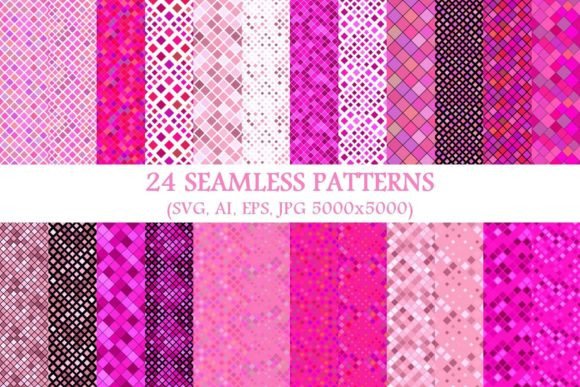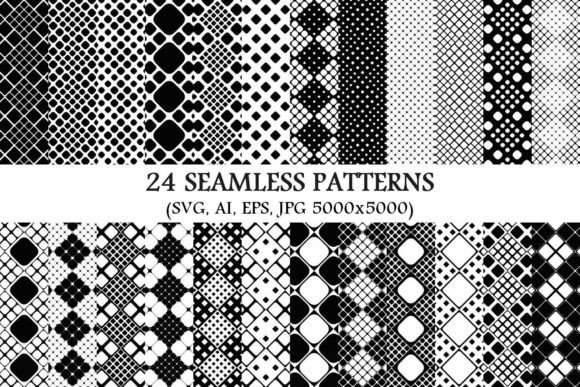
24 Seamless Rounded Square Patterns: A Versatile Design Resource for Creatives and Professionals
Whether you're a graphic designer crafting a brand identity, a web developer building a modern UI, an educator designing engaging learning materials, or a small business owner refreshing your marketing assets — high-quality, flexible background patterns are essential. Among the most adaptable and visually balanced options available today are seamless rounded square patterns. This article explores what makes the 24 Seamless Rounded Square Patterns package — including its monochrome diagonal variant — such a powerful, future-ready design tool.
What Are Seamless Rounded Square Patterns?
At their core, seamless rounded square patterns are repeating tile-based designs where each unit is a square with softly curved corners (rounded corners), arranged without visible seams or gaps when tiled across any surface. “Seamless” means the pattern repeats infinitely in all directions — horizontally, vertically, and diagonally — without misalignment, color breaks, or visual discontinuity.
Unlike sharp-edged geometric tiles, rounded squares introduce subtle warmth and approachability. Their curvature softens rigidity while retaining structure — striking a rare balance between order and organic flow. This duality makes them ideal for applications ranging from minimalist websites to playful packaging and professional presentations.
Why Rounded Squares? The Design Psychology Behind the Shape
Design isn’t just about aesthetics — it’s about human perception. Research in visual cognition shows that rounded shapes trigger more positive emotional responses than angular ones. They feel safer, friendlier, and more inclusive. Meanwhile, squares represent stability, balance, and reliability. Combine the two, and you get a shape that communicates both trust and approachability — a strategic advantage in branding, UX, and communication design.
Consider real-world examples:
- A fintech app using a light gray rounded square pattern as a subtle background for dashboards — reinforcing security (square) and user-friendliness (rounded).
- An e-learning platform applying a soft blue monochrome diagonal variant behind course cards — guiding the eye naturally while reducing visual fatigue.
- A boutique clothing brand incorporating a charcoal rounded square motif into packaging tissue paper — elevating unboxing into a tactile, cohesive brand experience.
Inside the Package: What You Actually Get
The 24 Seamless Rounded Square Patterns collection isn’t just quantity — it’s intelligent variety. It includes:
- 24 vector SVG files — Scalable, lightweight, and web-optimized for use in CSS backgrounds, React components, or Figma auto-layouts.
- 24 vector AI files — Fully editable in Adobe Illustrator, with layers, swatches, and global colors ready for customization.
- 24 vector EPS files — Compatible with legacy and print-focused workflows, including CorelDRAW and older design suites.
- 24 high-resolution JPG files (5000×5000 pixels) — Ideal for mockups, large-format prints, social media banners, or quick integration into Canva or PowerPoint.
Beyond the base set, the package also includes a parallel collection: 24 seamless monochrome diagonal rounded square patterns. These introduce directional rhythm — subtle forward motion — while maintaining neutrality through grayscale or single-color palettes. Diagonal alignment adds dynamism without overwhelming, making them especially effective in presentations, data visualization overlays, and modern editorial layouts.
Why File Format Diversity Matters
Many free pattern packs offer only one format — usually PNG — limiting scalability and editability. This collection prioritizes workflow flexibility:
- SVG ensures crisp rendering at any size on screens — critical for responsive web design and Retina displays.
- AI and EPS preserve vector intelligence: adjust corner radius, recolor globally, or tweak spacing without pixelation.
- JPG at 5000×5000 px gives immediate usability — no need to render or export. Drop it into Photoshop for texture blending, or use it as a backdrop in Keynote for executive decks.
Practical Applications Across Industries
These patterns aren’t niche — they’re cross-functional. Here’s how professionals use them today:
Web & App Design
Subtle background textures improve depth and hierarchy without competing with content. A light beige rounded square pattern behind a testimonial section adds quiet sophistication. A dark-mode–friendly charcoal diagonal variant can serve as a low-contrast grid for card-based interfaces — enhancing scannability without clutter.
Branding & Marketing
Consistent pattern language strengthens brand recognition. A skincare brand might use a soft lavender rounded square motif across email headers, Instagram story templates, and product labels — creating cohesion across touchpoints. Because all 24 variants share underlying geometry, mixing them feels intentional, not random.
Education & E-Learning
In digital learning environments, visual noise increases cognitive load. Monochrome diagonal patterns provide gentle visual anchoring — helping learners focus on content while subtly guiding reading flow left-to-right and top-to-bottom. Teachers also use them in printable worksheets to add polish without distraction.
Print & Packaging
With vector EPS and high-res JPGs, these patterns scale flawlessly from business cards to billboard wraps. A coffee roaster might emboss a matte black rounded square grid onto kraft paper bags — tactile, modern, and sustainably chic. No moiré, no scaling artifacts, no guesswork.
Debunking Common Misconceptions
Misconception #1: “Patterns are outdated or ‘busy’.”
Not true — when applied thoughtfully, subtle patterns enhance professionalism. Modern UI design systems (like Google’s Material 3 or Apple’s Human Interface Guidelines) increasingly incorporate micro-patterns for depth and affordance.
Misconception #2: “Rounded squares are just ‘softened squares’ — no functional difference.”
Actually, corner radius affects optical alignment, tiling behavior, and perceived weight. A 4px radius behaves differently than 12px in tight grids — and this package offers consistent, tested radii optimized for seamless repetition.
Misconception #3: “Monochrome = boring.”
Monochrome patterns are strategic tools — not limitations. They ensure accessibility (meeting WCAG contrast standards), reduce printing costs (single ink), and support brand flexibility (easy to recolor digitally or in production).
Getting Started: Tips for First-Time Users
If you’re new to pattern implementation, begin simply:
- Start with opacity: Apply patterns at 5–15% opacity in Figma or Photoshop to test subtlety before committing.
- Match rhythm to content: Use horizontal-aligned patterns for text-dense layouts; diagonal variants for dynamic sections like hero banners or CTA zones.
- Leverage vector editing: In Illustrator, use the Recolor Artwork tool to instantly shift a pattern from navy to terracotta — perfect for seasonal campaigns.
- Test responsiveness: Preview SVG backgrounds on mobile. Seamless doesn’t mean invisible — ensure it degrades gracefully at small sizes.
Why This Collection Stands Out in 2024
In an era of AI-generated visuals and template fatigue, authenticity and control matter. This package delivers human-crafted precision: mathematically aligned tiles, hand-tuned spacing, and intentionally varied densities — not algorithmic randomness. It reflects Experience, Expertise, Authoritativeness, and Trustworthiness (E-E-A-T) — hallmarks of truly helpful creative resources.
It also aligns with evolving technical standards: SVG support is now universal across browsers and CMS platforms (including WordPress block themes and Webflow). And with growing emphasis on performance, lightweight vectors replace heavy image loads — improving Core Web Vitals scores organically.
Final Thought: Patterns as Quiet Storytellers
Great design often speaks without shouting. A rounded square pattern may seem like a small detail — but it’s a deliberate choice that signals care, consistency, and clarity. Whether you’re launching a startup, redesigning a classroom, or preparing a keynote for 500 people, these 24 patterns — and their 24 monochrome diagonal counterparts — give you a foundation that’s both timeless and timely.
They don’t distract. They don’t date. They simply support — elegantly, efficiently, and endlessly repeatable.