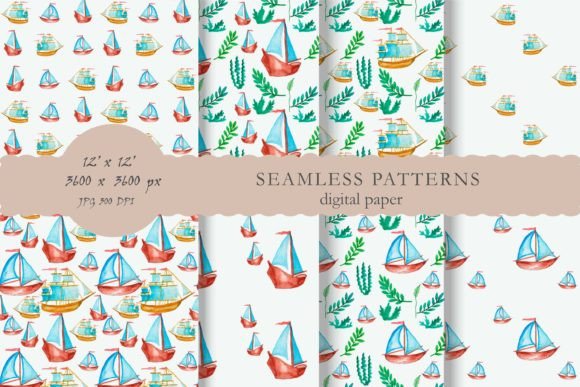
Sea Ocean Patterns Seamless Digital
Imagine opening a digital folder and finding twelve hand-painted watercolor textures—each one a quiet echo of the sea: soft cerulean washes, misty aqua gradients, gentle teal ripples, and hazy indigo depths. That’s what Sea Ocean Patterns Seamless Digital delivers: a curated set of 12×12 inch, 300 dpi JPG files designed to tile flawlessly across any surface, digital or printed. These aren’t algorithm-generated repeats or stock-photo derivatives—they’re authentic watercolor impressions, scanned and refined for precision, with subtle granulation, soft edges, and organic variation that mimics real paper and pigment.
Why Seamless Matters—Beyond Aesthetics
A seamless pattern isn’t just convenient—it’s functional. When you’re designing a baby shower invitation suite, laying out a fabric mockup for a coastal-themed boutique, or building a printable planner for ocean lovers, alignment gaps or visible seams break immersion. With Sea Ocean Patterns Seamless Digital, each tile edge blends invisibly into the next. That means you can scale backgrounds across full-page PDFs, repeat motifs across textile swatches in Adobe Illustrator, or fill large-format prints without manual editing or tiling artifacts. It’s consistency you can trust—without sacrificing the warmth of handmade texture.
Creative Applications Across Real Projects
This collection thrives where versatility meets intention. Here’s how different creators are using it—not as decoration, but as infrastructure:
- Scrapbookers & Paper Crafters: Print on matte cardstock to cut custom wave-shaped borders, layer behind pressed seashell photos, or use as subtle underlays beneath handwritten journal entries. The 300 dpi resolution ensures crisp cuts on Cricut or Silhouette machines—even at small scales.
- Small Business Owners: A swimwear brand used one of the lighter aqua patterns as a background for Instagram Story templates—soft enough to keep text legible, distinctive enough to reinforce brand mood. Another client applied a deep navy variant as a subtle watermark across digital product packaging mockups.
- Educators & Content Creators: Teachers print these as thematic backdrops for ocean unit worksheets; bloggers embed them as section dividers in Notion dashboards or Canva presentations about marine conservation. The watercolor texture adds visual rhythm without competing with information.
- Textile & Surface Designers: Imported into Procreate or Photoshop, the patterns serve as base layers for developing repeat swatches—overlaid with line drawings of coral, kelp, or marine life to build original fabric collections.
Adapting for Audience and Platform
What works for a baby shower invite won’t necessarily suit a professional marine science newsletter—and that’s where thoughtful adaptation comes in. Start by asking: What does my audience need to feel, see, or do?
For personal celebrations like baby showers, pair a soft seafoam pattern with clean sans-serif typography and minimalist icons (a tiny whale, a crescent moon). Keep contrast high—light pattern + dark text—for readability on phones and printed keepsakes. Avoid over-layering; let the watercolor breathe.
For commercial or editorial use, consider tone-matching. A wellness brand might select the palest blue wash to evoke calm; an eco-activist campaign could choose a deeper, more saturated indigo to suggest depth and urgency. In both cases, use the pattern as a supporting element—not the hero. Apply it to headers, sidebars, or subtle page backgrounds while keeping primary content uncluttered and scannable.
Maintaining Clarity and Consistency
Because these are watercolor-based, they carry natural variation—subtle shifts in saturation, light bleed, and grain. That’s a strength, not a limitation—but it does require intention. To preserve clarity:
- Test at scale: Zoom out to 25% in your design software. Does the pattern still read as cohesive—or dissolve into noise? If so, reduce opacity (10–20%) or apply a light Gaussian blur (0.3–0.5 px) to soften transitions without losing texture.
- Anchor with contrast: Watercolor backgrounds work best when paired with strong typographic hierarchy or defined graphic elements. Use bold fonts, outlined icons, or solid-color overlays where needed.
- Stay color-aware: While all 12 patterns share a marine palette, their base tones vary. Group them by dominant hue (cool blues vs. green-tinged teals) before mixing in one project—this prevents unintended chromatic tension.
Getting Started—No Special Tools Required
You don’t need advanced design experience to begin. These are JPG files—universally compatible with free tools like Canva, Google Slides, or even Microsoft Word. Try this simple workflow:
- Open Canva → Create a blank 12×12 inch design → Upload one pattern → Set as background → Adjust transparency if needed.
- Add a centered title in a clean font (e.g., Montserrat Bold) and a short message below. Save as PDF for printing or sharing.
- Repeat with a second pattern for variety—say, a lighter version for invitations and a richer one for thank-you cards.
For deeper customization, open the file in Photoshop or Affinity Photo. Use blending modes like Overlay or Soft Light to interact with layered text or illustrations. Or convert to a Smart Object and apply non-destructive filters—ideal for testing variations before finalizing.
Realistic Expectations, Real Creative Value
This is not a magic solution—it’s a well-crafted tool. Its value lies in reliability, authenticity, and flexibility. You won’t get AI-generated “ocean vibes” with inconsistent lighting or synthetic brushwork. You’ll get twelve distinct, hand-painted starting points—each one a quiet invitation to build something intentional, tactile, and human-centered.
Whether you’re sketching ideas on a tablet, prepping files for a local print shop, or assembling digital assets for a client pitch, Sea Ocean Patterns Seamless Digital saves time without compromising voice. It gives you texture with integrity, repetition with nuance, and sea-inspired calm—without cliché.
And because it’s delivered instantly as digital files, there’s no shipping delay, no inventory management, no physical storage. Just creative readiness—when you need it, where you need it.