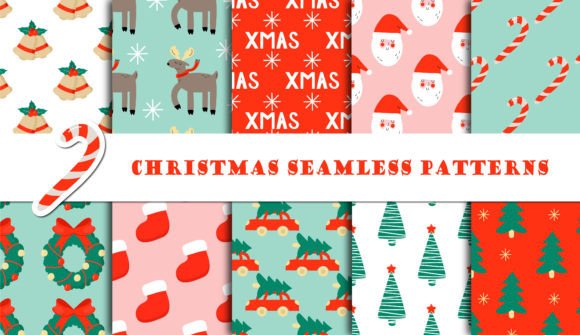
Christmas Seamless Patterns, Cute Papers
Christmas Seamless Patterns, Cute Papers is a compact, high-fidelity digital paper collection designed for creators who need authentic, hand-crafted holiday visuals without the time or technical overhead of building from scratch. Unlike mass-produced clip art or algorithmically tiled vectors, this set features three original 12×12 inch papers—each hand drawn and painted by Collart Studio—then digitally optimized for seamless tiling at 300 dpi. The result is a small but intentional resource: not a sprawling bundle, but a curated selection built for real-world reuse across both physical and digital projects.
What Sets These Papers Apart
The distinction lies in execution and origin. Each paper begins as an analog artwork—ink lines, watercolor washes, subtle texture, deliberate imperfections—then scanned and carefully refined to preserve warmth while ensuring technical reliability. You’ll notice soft edges on holly sprigs, uneven pigment pooling in berry clusters, and slight variations in line weight that signal human authorship. That authenticity translates directly into usability: when scaled or repeated, these patterns avoid the sterile repetition common in AI-generated or vector-based tiles. There’s no “looping artifact” at tile boundaries—just natural, organic continuity.
Because they’re delivered as high-resolution raster files (not vectors or low-DPI JPEGs), they hold up in print applications like invitations, planner stickers, and fabric printing—without pixelation or loss of detail. At the same time, their clean color separation and balanced contrast make them adaptable for web use: blog headers, email newsletter backgrounds, or social media templates where festive tone matters but visual clutter doesn’t.
Practical Use Across Workflows
Professionals integrating Christmas Seamless Patterns, Cute Papers into existing systems report minimal friction. Designers using Adobe Creative Suite can drag files directly into Photoshop or Illustrator as smart objects or pattern swatches. Canva users paste them as background layers—scaling works reliably thanks to the 12×12 inch base size and 300 dpi resolution. For educators preparing classroom materials, the papers serve as consistent visual anchors across handouts, reward tags, or bulletin board borders—no licensing concerns, no attribution required beyond studio credit if desired.
In scrapbooking and DIY contexts, the papers perform well with standard home printers (especially pigment-ink models) and cutters like Cricut or Silhouette. Users testing them for decoupage noted that the subtle grain and muted palette resist looking “digital” when layered with matte mod podge or pressed onto wood or ceramic surfaces. One small business owner used a single paper as the repeating background for holiday product packaging inserts—replacing a custom illustration commission that would have cost four times as much and taken three weeks.
Strengths in Flexibility and Consistency
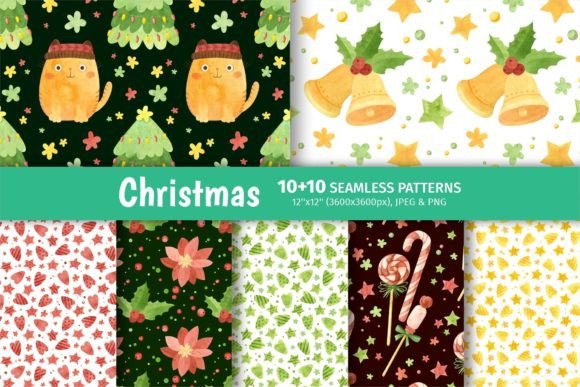
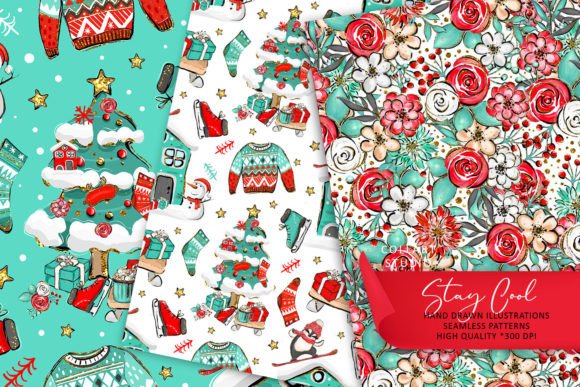
Though only three papers are included, they cover complementary moods: one leans traditional (red-and-green wreaths with gold accents), another is minimalist and modern (soft sage and cream botanical linework), and the third introduces gentle whimsy (tiny hand-drawn ornaments and candy canes with visible brushstrokes). This variety allows mixing within a single project—say, using the minimalist paper for planner sticker bases and the traditional one for invitation borders—without visual dissonance. All share the same color temperature and paper-tone base, so overlays, cropping, or selective masking remain straightforward.
Consistency extends to file delivery: each is named clearly (e.g., Collart_Christmas_Wreath_300dpi.tif), saved in standard TIFF format for maximum compatibility, and includes embedded color profiles (sRGB for screen, CMYK-ready for print workflows). No ZIP password hurdles, no license ambiguity—just immediate access after purchase.
Who Benefits Most—and When
This collection suits professionals and serious hobbyists who prioritize craft over convenience—but still value efficiency. Freelance graphic designers building seasonal brand assets for clients appreciate having a trustworthy, rights-cleared source that avoids stock photo platform restrictions. Bloggers and educators creating themed lesson plans or downloadable resources find the papers ideal for maintaining visual cohesion across multiple PDFs or printable kits—without needing design expertise.
Small business owners launching limited-edition holiday products—think handmade soap labels, greeting card lines, or subscription box inserts—use these papers to establish recognizable, non-generic branding fast. One candle maker applied the minimalist paper as a foil-stamped background on kraft boxes, achieving a premium look without custom plate costs. Similarly, wedding stationery designers repurpose sections as envelope liners or RSVP card textures—cropping individual elements (like a single sprig or ornament) as standalone SVG-ready clip art via manual tracing, since the hand-drawn originals provide clean, scalable reference points.
Realistic Considerations and Limitations
These are raster-based papers—not vector files—so extreme enlargement beyond 200% may reveal pixel structure, especially when printed on glossy stock. They’re also not animated, interactive, or responsive by nature; for web banners or dynamic email layouts, users should treat them as static background layers rather than flexible UI components. And while the palette is intentionally restrained (avoiding neon or overly saturated tones), it may not align with brands requiring strict Pantone matching—though CMYK conversion tests show predictable, reproducible results on standard commercial presses.
There’s no built-in resizing tool or automated tiling script included—users must manage repeats manually in their preferred software. That’s a constraint for absolute beginners, but a feature for those who prefer full control over scale, opacity, and blending modes. It also means no automatic updates or versioned releases—what you receive is what’s been tested and finalized.
Long-Term Value and Integration
Unlike trend-driven assets that feel dated after a season, Christmas Seamless Patterns, Cute Papers lean into timeless techniques: hand-drawn linework, natural pigment behavior, and classic holiday motifs rendered without irony or excessive stylization. That gives them longevity—they’re as viable for 2025 holiday campaigns as for 2024 ones. Several users report reusing cropped sections year after year: a single holly cluster becomes a recurring icon in social bios; a ribbon motif gets isolated and resized for digital planner tabs.
Because they’re created by a single studio with a defined aesthetic, there’s no risk of mismatched styles across the set—a common issue in larger bundles assembled from disparate contributors. That coherence supports brand-building efforts where visual trust matters: think Etsy shop banners, Substack newsletters, or educator resource sites aiming for calm, considered professionalism rather than visual noise.
If your workflow involves seasonal content creation, client-facing deliverables, or hands-on crafting—and you’ve spent time adjusting brightness on generic downloads or redrawing motifs to avoid copyright issues—Christmas Seamless Patterns, Cute Papers offers a quiet, effective alternative. It won’t replace full illustration commissions for bespoke needs, but it reliably fills the gap between generic and custom: original, usable, and grounded in actual making.