48 Seamless Floral Mandala Patterns
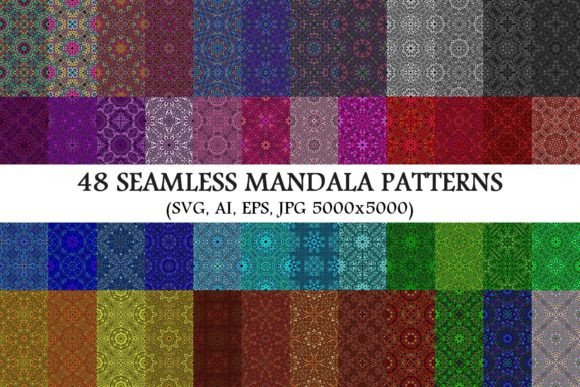
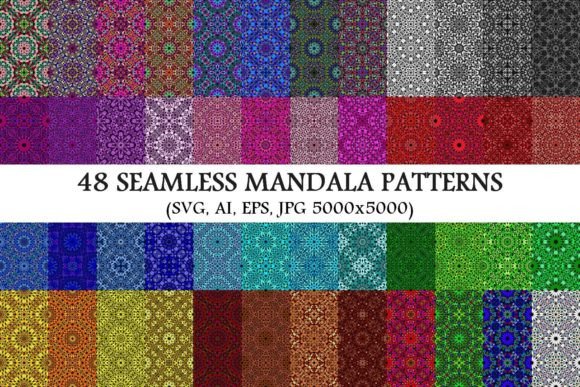
These aren’t just repeating backgrounds—they’re hand-crafted visual anchors. Each of the 48 Seamless Floral Mandala Patterns balances botanical intricacy with geometric calm: think layered petals, symmetrical vines, and delicate radial rhythms that flow without visible seams. There’s no harsh digital rigidity here—lines breathe, curves soften at the edges, and negative space is treated with as much intention as the florals themselves. The collection leans into organic elegance rather than maximalist density, making it equally at home on a minimalist wedding invite or a bold textile print.
Where These Patterns Earn Their Keep
Because they’re built as true seamless repeats—not tiled JPEGs or stretched vectors—these patterns scale flawlessly across formats and sizes. That means you can drop one into a 5000×5000px social media banner and then reuse the same asset for a 36″×48″ wall mural, a fabric swatch, or the background of a branded presentation slide—without reworking alignment or worrying about edge breaks.
Designers use them in editorial design for chapter dividers and section headers; crafters adapt them for laser-cut templates and embroidery guides; small business owners apply them to packaging labels, product tags, and Shopify store banners. Bloggers layer them behind quote graphics; publishers embed them into ebook cover textures; marketers build cohesive Instagram story series using subtle variations across the set. Even physical products benefit: one client recently printed a subset onto kraft paper gift wrap, while another used three patterns to differentiate scent variants in a candle line—each pattern quietly reinforcing a unique mood (serene, romantic, grounded) without changing typography or color palette.
More Than Just Pretty Repeats
What makes this package unusually practical isn’t just quantity—it’s format depth and intentional consistency. You get 48 vector SVG files, each editable down to individual paths in Figma or Illustrator; 48 vector AI files for full Adobe ecosystem control; 48 vector EPS files for legacy print workflows; and 48 high-res JPGs (5000×5000px) ready for immediate use in Canva, Photoshop, or web CMS platforms. No upsampling. No pixelation. No “convert to outlines” surprises.
The uniform sizing and consistent stroke weights across all 48 pieces mean you can mix and match without visual whiplash. One pattern might emphasize tight concentric rings; another opens up with trailing jasmine stems—but because contrast ratios, line thicknesses, and floral density were calibrated across the board, swapping one for another mid-project feels intuitive, not disruptive.
Choosing & Pairing With Intention
Start by asking: What role does the pattern play? If it’s a background for body text (like in a lookbook or newsletter), lean toward lower-contrast, sparser mandalas—ones where the floral rhythm supports, rather than competes with, readability. For hero sections or packaging, bolder, higher-density patterns hold attention without needing extra graphic elements.
When pairing with type, avoid competing ornamentation. A clean sans serif like Inter or Lato creates useful tension against the organic flow—especially at smaller sizes. For luxury branding, try a restrained serif like Cormorant Garamond: its gentle serifs echo the hand-drawn warmth of the florals without mimicking them. Steer clear of script fonts unless you’re going for intentional contrast (e.g., a single handwritten tagline over a structured mandala), as overlapping flourishes can muddy hierarchy.
Test early. Place your chosen pattern behind real copy—not lorem ipsum—at actual intended sizes. Zoom out to 25%. Does the text remain legible? Does the pattern recede appropriately, or does it vibrate or distract? If it pulls focus, reduce opacity slightly (10–15%) or add a subtle white-to-transparent gradient overlay. These are design assets, not magic bullets—and their strength lies in how thoughtfully they’re integrated.
Licensing That Matches Real Workflows
This is a commercial font—but wait, it’s not a font. Let’s clarify: these are seamless vector patterns, not typography. Still, licensing matters just as much. The package includes an extended commercial license: you may use them in client work, sell products featuring them (mugs, notebooks, apparel), and distribute digitally (ebooks, templates, Canva elements)—no attribution required. What’s excluded? Reselling the patterns themselves as standalone assets or claiming copyright over the original designs. That’s standard, fair, and aligned with industry practice for design assets of this scope.
If you’re building a brand identity system, these patterns can become part of your brand identity language—think textured email footers, custom divider lines in pitch decks, or recurring motifs across merch. Because every file is vector-based and resolution-independent, they grow with your business: from Etsy listings today to wholesale catalog layouts next year.
A Few Quiet Strengths Worth Noticing
- No “empty” patterns: Even the most minimal mandalas include subtle variation—leaf angles shift, petal overlaps differ—so large surface coverage never feels robotic.
- Color-agnostic design: All files are grayscale vector or JPG, letting you recolor instantly in any tool—no need to wait for alternate palettes or request custom versions.
- Consistent spacing logic: The repeat tile size is standardized across all 48, so switching between patterns in a single document doesn’t require resizing or repositioning.
- Realistic file naming: Files are labeled descriptively (e.g., floral-mandala-23-tight-vine), not cryptically—saving minutes per project when scanning thumbnails in crowded folders.
They won’t replace thoughtful layout, smart color choices, or strong writing. But when you need a foundation that feels intentional, scalable, and quietly distinctive—something that adds texture without shouting—the 48 Seamless Floral Mandala Patterns deliver with quiet reliability. Not as decoration, but as infrastructure.