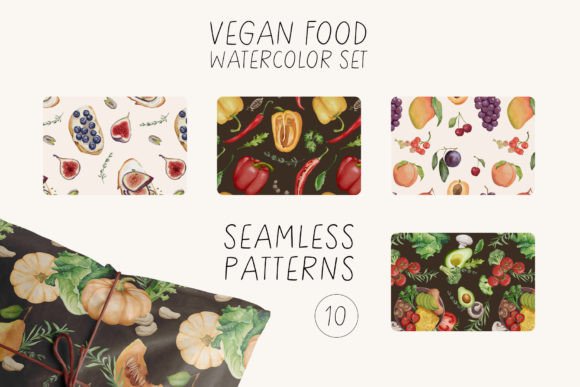
Vegan Food Patterns
When you’re designing for a vegan brand, café, or wellness-focused project, visuals matter as much as values. Vegan Food Patterns isn’t just another clipart pack—it’s a thoughtfully curated set of 10 seamless watercolor patterns featuring fresh lettuce leaves, vibrant berries, ripe fruits, wholesome plant-based meals, and even delicate desserts and drinks. Each design celebrates the color, texture, and vitality of whole-food vegan nutrition—not as a restriction, but as abundance. That intention shows up in every brushstroke: soft yet confident, organic yet polished, nourishing in both message and medium.
Why designers and small business owners reach for this set
Whether you're updating your vegan café’s menu, printing linen napkins for a farm-to-table wedding, or developing packaging for a new line of oat-milk chocolates, cohesive, on-brand visuals save time and strengthen trust. These patterns work because they’re built for real-world use—not just inspiration boards. They’re high-resolution (300 dpi), transparent-background PNGs, meaning they drop cleanly into Canva, Adobe Illustrator, or Procreate without clipping or pixelation. And because they’re seamless, you can tile them across fabric, wrapping paper, or digital backgrounds without visible repeats.
A common mistake: Assuming “vegan-themed” means generic produce graphics
Many creators search for “vegan clipart” or “plant-based icons” and end up with stiff, cartoonish, or overly literal illustrations—think isolated broccoli heads or smiling soy milk cartons. Those rarely translate well to elegant stationery, textile design, or premium packaging. Vegan Food Patterns avoids that trap by focusing on *composition*, not categorization. A pattern might layer fig slices with thyme sprigs and a whisper of almond milk foam—not to label something “vegan,” but to evoke a sensory, seasonal, and intentional food experience. That subtlety makes the designs feel mature, inclusive, and commercially versatile.
Overlooking resolution and format—and paying for it later
It’s easy to download a “free watercolor pattern” only to discover it’s 72 dpi, has a white background, or tiles poorly at larger scales. That becomes obvious when you try printing a 24"x36" wall menu or embroidering a pattern onto tea towels. With Vegan Food Patterns, all 10 files arrive ready: 300 dpi, transparent background, seamless tiling confirmed. No upsampling, no background removal, no guesswork. If you’re ordering fabric through Spoonflower or printing on recycled kraft paper, that technical readiness directly affects color fidelity, edge clarity, and production cost.
What to verify before using or purchasing
- Transparency support: Does your design tool handle alpha channels? Test one pattern in your workflow first—especially if you’re layering over photos or textured substrates.
- Scale intent: These patterns shine at both small (sticker sheets, recipe cards) and large (wallpaper, tablecloths). But avoid stretching a single tile beyond its native dimensions—seamless doesn’t mean infinitely scalable without softening.
- Color consistency: Watercolor textures vary in saturation and grain. If you’re matching to a specific brand palette (e.g., muted sage + terracotta), open the files in your color picker first. The natural variation is a feature—but it’s worth previewing alongside your existing assets.
Misusing patterns as standalone elements instead of supporting layers
One overlooked opportunity? Treating these as decorative accents rather than foundational design systems. A single pattern works beautifully as a subtle background behind a handwritten menu item—but layered with a custom-drawn icon or hand-lettered header, it creates depth and warmth that feels handmade, not templated. Try lowering the opacity to 15–25% behind typography, or use a clipping mask to confine a berry pattern to the shape of a gift tag. That kind of intentional layering turns “pretty graphics” into distinctive brand language.
Assuming one set fits all vegan audiences
Veganism spans many identities: athletes focused on protein density, parents seeking kid-friendly snacks, seniors prioritizing digestibility, or climate-conscious shoppers reading ingredient lists like manifestos. Vegan Food Patterns reflects that range—not with labels, but with visual cues. You’ll find hearty lentil stews beside bright açai bowls, roasted carrots next to candied ginger slices. That breadth helps avoid unintentional stereotyping (e.g., only “green juice” imagery) and supports inclusive messaging—whether you’re designing for a Brooklyn juice bar or a Kerala-inspired vegan meal kit.
Practical tips for getting the most out of the set
- Start with context, not decoration. Ask: What feeling should this piece communicate? Calm (soft greens + blurred herbs)? Celebration (berries + gold foil accents)? Nourishment (grains + steamed greens)? Let the pattern support that tone—not drive it.
- Test print early—even on plain copy paper. Screen colors lie. A rich plum in RGB may flatten on uncoated stock. Seeing how pigment weight and transparency interact on paper reveals what adjustments (if any) your printer needs.
- Respect the watercolor honesty. These aren’t vector-perfect shapes—they have gentle bleed, subtle granulation, and soft edges. That’s their strength. Don’t over-sharpen or auto-trace unless you’re intentionally going for contrast; let the texture breathe.
If you're sourcing visuals for a vegan bakery launch, a nutrition educator’s workshop handouts, or even a mindful living journal, Vegan Food Patterns offers more than aesthetics—it offers alignment. Alignment between ethics and execution, simplicity and sophistication, flavor and form. And because each file is delivered cleanly and clearly—with no hidden licenses or usage limits—you invest time once, not repeatedly troubleshooting compatibility or rights.
As Yuliia notes, questions are welcome. That openness reflects the care behind the collection: it’s made by someone who understands that good design for vegan values shouldn’t require decoding, compromise, or correction—it should feel like the first satisfying bite of something thoughtfully made.