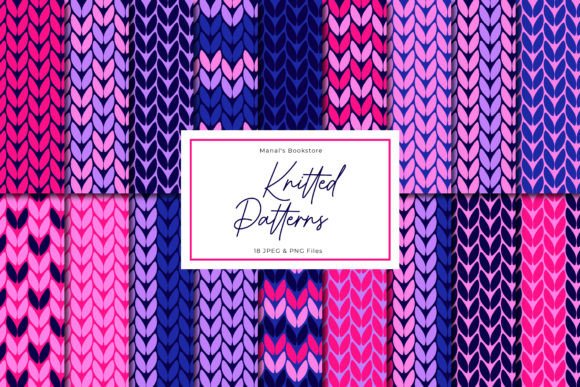
18 Knitted Patterns
The 18 Knitted Patterns and Knitted Seamless Patterns Pack is a digital asset collection consisting of 36 high-resolution raster files—18 in JPG format and 18 in PNG format—each sized at 3600×3600 pixels. These are not vector illustrations or editable design templates, but rather ready-to-use, seamless knitted texture patterns rendered as flat, repeatable image files. Each pattern mimics the visual rhythm and tactile quality of hand-knitted or machine-knitted fabric, with variations in stitch density, cable twists, ribbing, and color palettes.
This pack serves creators who need consistent, scalable textile-inspired visuals for physical and digital applications. It is intended for users who require plug-and-play assets—not custom-designed motifs, not layered PSD files, and not SVG-based scalable graphics—but clean, high-fidelity raster images optimized for print and screen use.
Why Consider This Pattern Pack?
Designers, crafters, and small-business owners often face recurring needs: a background texture for greeting cards, a subtle fabric overlay for web banners, or a cohesive set of repeating elements for fabric printing. The 18 Knitted Patterns pack addresses these needs by offering a curated, uniform set of textures that share stylistic continuity and technical consistency. Because all files are delivered at identical dimensions and resolution, users avoid time spent resizing, aligning, or adjusting contrast across disparate sources.
Its appeal lies in practicality: the PNG files include transparent backgrounds, making them suitable for layering over photos or colored surfaces without manual masking. The JPG versions provide smaller file sizes and broader compatibility for uses like large-format printing or web backgrounds where transparency isn’t required.
Key Benefits and Realistic Expectations
Consistency and readiness are primary advantages. All 18 patterns are designed to tile seamlessly—meaning they can be repeated horizontally and vertically without visible seams or misaligned edges. This eliminates the need for manual blending or edge correction when used in scrapbooking, planner layouts, or fabric repeats.
Resolution support is another strength. At 3600×3600 pixels, each file scales well for A4/A3 prints, T-shirt transfers, and even moderate enlargements for wall art or home décor. However, users should note that raster files do not scale infinitely: extreme enlargement beyond 200% of native size may reveal pixelation, especially in fine-stitch details.
No editing flexibility is a tradeoff. Unlike vector-based knitting patterns or layered design files, these JPG and PNG assets cannot be recolored non-destructively, adjusted for stitch width, or modified to change yarn thickness. If a project requires precise hue matching or dynamic scaling across multiple output formats (e.g., embroidery digitizing or laser-cut stencils), this pack does not provide those capabilities.
When This Pack Is a Strong Fit
The 18 Knitted Patterns set works well for users whose workflows prioritize speed and cohesion over customization. For example:
- A cardmaker producing seasonal greeting cards can apply multiple patterns from the set to maintain a unified “handmade knit” theme across product lines.
- A blogger or educator creating printable knitting-themed planners or worksheets benefits from having a library of on-brand, copyright-cleared textures.
- A small apparel brand developing limited-run tote bags or scarves may use the patterns as surface designs for digital fabric printing—provided their printer accepts high-res JPG/PNG files and supports seamless tiling.
- A website designer building a craft-supply store or yarn shop landing page can incorporate the patterns as CSS background images or hero-section overlays, leveraging the transparency in PNGs for responsive layering.
In each case, the value comes from having a dependable, pre-tested set of visuals that behave predictably across tools—from Adobe Photoshop and Canva to Cricut Design Space and Microsoft PowerPoint.
When Alternatives May Be More Appropriate
This pack is less suitable for users requiring adaptability. If your work involves frequent color adjustments, multi-layer compositions, or integration into parametric design systems (e.g., generative art tools or CAD-based textile simulation), vector-based knitting pattern libraries or SVG resources would offer greater control.
Similarly, if you’re sourcing patterns for commercial embroidery, screen printing, or sublimation on stretch fabrics, you’ll likely need vector outlines or stitch-specific files—not raster textures. Embroidery software typically requires DST, PES, or EXP formats; screen printers often prefer spot-color separations or vector paths for clean halftone reproduction.
For educators or designers seeking to teach or demonstrate knitting techniques—not just depict them—complementary resources such as schematic diagrams, stitch charts, or video tutorials would better serve pedagogical goals than static texture files.
Making an Informed Decision
To determine whether the 18 Knitted Patterns pack aligns with your needs, consider three questions:
- What is your primary output medium? If most of your projects involve print-on-demand services, digital stationery, or social media graphics—and you rely on raster-based tools like Photoshop, Procreate, or Canva—this pack delivers appropriate fidelity and format support.
- How much variation do you need? With 18 distinct patterns, the set offers moderate diversity: some feature tight stockinette, others show open lace or bold cables. But it does not include seasonal variants (e.g., holiday-themed stitches) or monochrome-only options. Review previews carefully to assess stylistic range before purchase.
- Do you need licensing clarity? The description states the files are for personal and commercial use, but verify whether attribution is required and whether redistribution (e.g., bundling into your own digital product) is permitted. Licensing terms vary by seller and platform, and are not inherent to the file format itself.
Finally, remember that pattern utility depends as much on workflow integration as on visual quality. Test one or two files in your usual design environment before committing to the full set. Import a PNG into your preferred layout tool, apply it as a background, and check how it interacts with text overlays or photo layers. That hands-on evaluation reveals more than any description about whether the pack fits your actual process.
Ultimately, the 18 Knitted Patterns pack is a focused, execution-oriented resource—not a comprehensive design system, but a reliable component within one. Its usefulness emerges not from novelty or breadth, but from consistency, resolution, and immediate usability across common creative tasks.